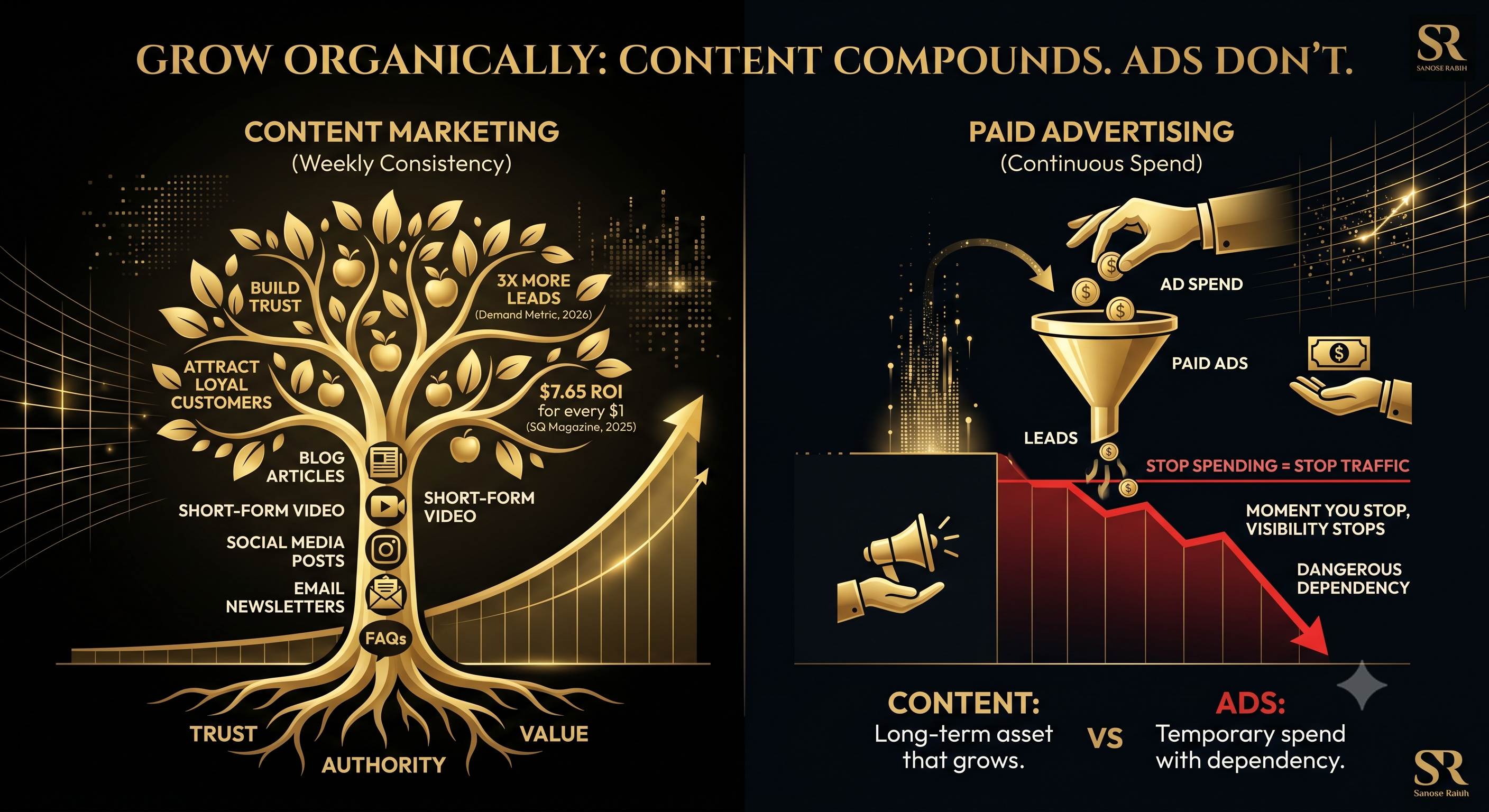
1The Problem With Relying Only on Paid Ads
Paid advertising works — but only while you're paying. The moment you stop, the traffic stops. The leads stop. The visibility disappears. For small businesses with limited budgets, this creates a dangerous dependency: spend money to exist, or become invisible.
Content marketing works differently. A well-written blog post, a genuinely helpful video, or a clear explanation of your service can continue attracting customers for months — or years — after you create it. It compounds. Ads don't.
According to research compiled by Demand Metric and validated by the Content Marketing Institute (2026), content marketing costs 62% less than traditional outbound marketing while generating approximately 3 times as many leads. For small businesses, this isn't a minor efficiency gap — it's the difference between a sustainable long-term strategy and an expensive ongoing dependency.[1]
2What Content Marketing Actually Means
Content marketing is a deliberate strategy: create material that your ideal customer finds genuinely useful, and let that value build trust over time. That trust is what eventually converts a stranger into a paying client — not because you sold them something, but because you helped them before they were ready to buy.
In 2026, 82% of marketers actively invest in content marketing — up 12% compared to 2024, according to HubSpot's State of Marketing Report.[2] This is not an experimental channel. It has become a core business function.
Content Takes Many Forms
- Blog articles — answer the questions your customers are already searching for on Google
- Social media posts — share insights, results, and behind-the-scenes from your business
- Short-form video — show your process or expertise in 30–90 seconds; the highest-ROI format in 2026[3]
- Email newsletters — keep existing customers engaged and remind past clients you exist
- Frequently Asked Questions — address objections before the customer even raises them
A halal butcher shop that publishes a weekly post about different cuts of meat, how to prepare them, and where they source from — builds far more trust than one that only posts "Sale this weekend." The first educates. The second interrupts.
3Why Content Works — Current Data
The research on this is consistent and recent. Here are the figures that matter for small businesses in 2025–2026:
- Businesses with active blogs generate 67% more leads per month and 55% more website traffic than non-blogging competitors [4]
- 63% of consumers prefer to find information about brands and products through content rather than traditional advertising [5]
- Companies with a documented content strategy are 3.5× more successful than those without one [6]
- The average content marketing program returns $7.65 for every $1 spent across all channels [7]
- 68% of businesses report increased content ROI as a direct result of AI-assisted content production [8]
The pattern is consistent across all major industry reports: customers who find you through content are more qualified, more trusting, and more likely to buy than customers who see an ad. They came to you — you didn't interrupt them.
4The Content Formats That Drive Real Results in 2026
Not all content is equal. Research in 2026 shows a clear shift in which formats perform best:
Short-Form Video — Highest ROI Format in 2026
Short-form video generated the highest return on investment among all content formats in 2026, with 104% more marketers naming it their most valuable channel compared to the previous year.[3] For small businesses, this means 30–90 second videos showing your product, process, or expertise represent one of the most cost-effective content investments available.
Answer-Based Blog Content
Write articles that answer the exact questions your customers type into search engines. If you run a cleaning service, write "How often should you deep clean your home?" If you run a security company, write "What questions should I ask before hiring a security guard?" Every answered question is a potential customer who finds you instead of your competitor.
Organic search and SEO remain the top-performing long-term channels for both B2B and B2C brands, according to HubSpot's 2025 State of Marketing Report.[2]
Bilingual Content — An Underserved Advantage
Content in Arabic — with correct grammar and cultural context — immediately differentiates any Arab-owned business from competitors who only communicate in English. This is a built-in audience that most businesses in the same space are not serving. The combination of Arabic and English content doubles the potential reach without doubling the effort.
5How to Start Without a Big Budget
The most common misconception about content marketing is that it requires a team, a studio, and a large monthly budget. It doesn't. It requires consistency and a genuine intention to help.
Start With One Channel
Choose the single platform where your ideal customers already spend time — and commit to it. For most small businesses in the USA, that is Facebook or Instagram. For service businesses targeting professionals, it is LinkedIn. Do not try to be everywhere at once. Be consistent somewhere specific.
A Practical Weekly Publishing Schedule
- Monday: One educational post — a tip, a fact, or a how-to
- Wednesday: One trust-building post — behind-the-scenes, process, or team
- Friday: One engagement post — a question, a poll, or a relevant community topic
Three posts per week. Done consistently over three months, this builds more authority and trust than a single paid campaign run once with a larger budget.
Repurpose Everything
One blog article becomes five social media posts. One video becomes a transcript becomes a post becomes a story. Content created once can serve across multiple formats and platforms — multiplying reach without multiplying effort. Research shows this is how most successful small content operations scale without additional headcount.
The real investment in content marketing is time, not money. For small businesses that cannot compete on advertising spend, this is the most significant competitive advantage available to them in 2026.
6What Separates Content That Converts From Content That Doesn't
Content that attracts customers is consistently more useful than it is promotional. Most small businesses make the same mistake: they create content that is essentially an advertisement in a different format. "Our service is the best. Contact us now." That is an interruption — not content.
The Three-Part Test for Effective Content
- Is it useful? Does it answer a real question or solve an actual problem your customer has today?
- Is it honest? Does it represent your business accurately, without exaggeration or unsubstantiated claims?
- Is it consistent? Is it part of a regular publishing schedule, or a one-time effort that will be abandoned?
Content that passes all three criteria will work — not immediately, but with compounding effect over time. It attracts customers who already trust you before the first conversation begins.
7A Practical Starting Point for This Week
If you own a small business and you are reading this, here is the most actionable thing you can do in the next seven days:
- Write down the five questions your customers ask most often — before buying, during the process, and after
- Turn each question into a short, honest answer written in plain language, not marketing language
- Publish one of those answers this week — as a post, a short video, or a simple graphic with text
- Repeat next week with a different question
That is content marketing. The businesses that succeed at it are not the ones with the best tools — they are the ones who showed up consistently when others did not.
8Conclusion
Paid advertising has its place. But for small businesses building for the long term, content is the foundation — it costs less, builds more trust, and keeps working after the campaign ends. The businesses investing in content today are building an asset that grows in value with every piece they publish.
You do not need a large budget to attract great customers. You need something more valuable: something useful to say, and the discipline to say it consistently.
Not Sure Where to Start?
Request your free AI marketing audit. I will personally review your current presence and send you a clear, honest starting point — within 24 hours, no commitment required.
Get My Free Audit →Sources & References
- Demand Metric / Content Marketing Institute (2026). Content marketing cost efficiency: 3× leads at 62% lower cost. Cited by multiple 2025–2026 aggregators.
searchlab.nl — Content Marketing Statistics 2026 - HubSpot State of Marketing Report (2026). 82% of marketers actively invest in content marketing; organic search and SEO as top-performing channels.
blog.hubspot.com — 2026 State of Marketing - KLIQ Interactive / HubSpot (2026). Short-form video: 104% more marketers named it top channel in 2025 vs. prior year.
hubspot.com/marketing-statistics - OmniBound / Firework (2026). Companies with active blogs generate 67% more leads per month and 55% more website traffic.
omnibound.ai — Content Marketing ROI Statistics - HubSpot Consumer Research (2025). 63% of consumers prefer to find information about brands through content rather than traditional advertising.
hubspot.com/marketing-statistics - Content Marketing Institute — B2B Content Marketing Insights for 2026. Companies with documented content strategies are 3.5× more successful.
contentmarketinginstitute.com/research - SQ Magazine (2025). Average content marketing ROI: $7.65 per $1 invested across all channels.
omnibound.ai — Content Marketing ROI Statistics - Revenue Memo / DemandSage (2026). 68% of businesses report increased content ROI as a direct result of AI-assisted content production.
demandsage.com — Content Marketing Statistics 2026
All statistics in this article are sourced from published industry research dated 2025–2026. Sources are listed in order of appearance. Links verified as of June 2026.
Published Saturday, June 13, 2026 · Sanose Rabih | AI Marketing Specialist · Sacramento, CA
Part of the Digital Marketing Insights weekly series